

Becoming Asymmetrical
A remedy for the unlevel

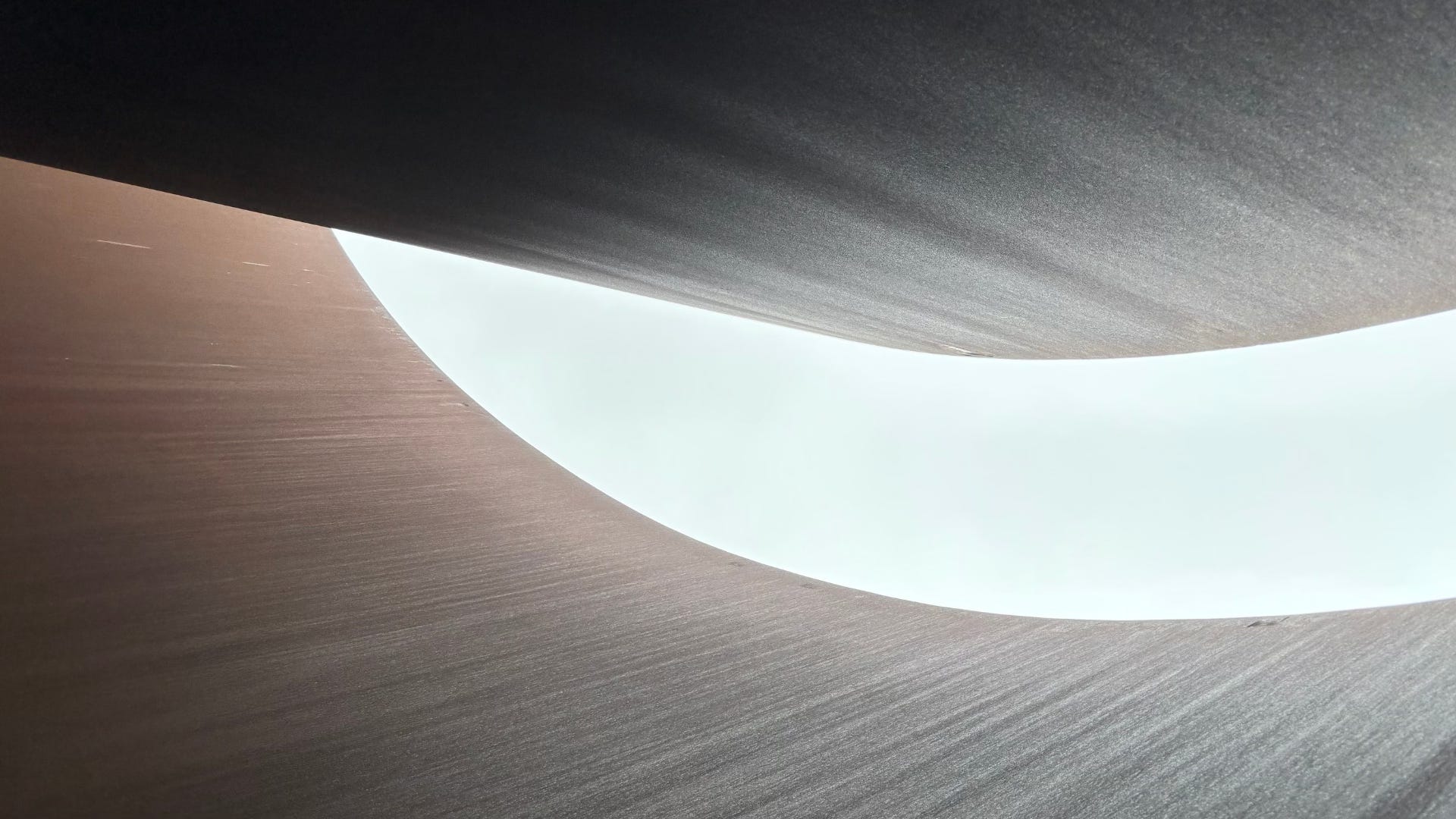
Picture inside of Sylvester at Glenstone Museum
There is a museum near Potomac, Maryland, where the art does not only hang on walls — it stands in fields, curves through landscape, asks your body to respond before your mind catches up. At Glenstone, Alexander Calder’s words are written into the exhibition halls: “Anything suggestive of symmetry is decidedly undesirable.” And outside, *Richard Serra’s Sylvester (2001) — two massive torqued spirals of weatherproof steel — holds a space so disorienting, so alive, that standing inside it feels like transformation itself. My husband said: dizzy. I thought: losing symmetry. This reflection is what arrived after the visit.
Symmetria.
The Greeks give us this word — syn, together, metros, measure — not as a command to match yourself, but as a question:
What shares a common measure with you? What is in proportion? What belongs to the same wholeness?
In the body, symmetria is not performance.
It is the language the body speaks
before anyone is watching —
the way the heart knows
which side to lean toward,
the way the spine organizes itself
around an invisible axis
of becoming.
Biology understands this first: not mirror perfection, but functional coherence — two lungs, asymmetric in size, making room for the heart’s lean. Two hemispheres of the brain, each carrying what the other cannot. The face itself, never truly even — the side that laughs more, the side that holds the grief.
This is the original symmetry. Not sameness. Proportion through purpose.
Somewhere we forget.
We turn symmetry into performance —
the composed face,
the answer that lands clean,
the wound tucked behind
the scheduled meeting.
We learn to match ourselves:
the leader we are told to become
pressed flat against
the leader we actually are.
We call this professionalism. We call this having it together.
Sometimes we call it leadership.
And our bodies
— faithful, truthful —
keep the record
of everything we perform our way past.
The tightness in the shoulders
that arrives before the difficult conversation.
The breath that goes shallow
in the room where we are not allowed
to not-know.
The bone-deep exhaustion
of holding a shape
the body never agrees to.
The body as archive.
The body as witness.
The body, always,
as the site of the real work —
invisible,
patient,
waiting to be read.
But I walk between two walls of weathered steel
at Glenstone, on a quiet afternoon,
and the sculpture does not care about my symmetry.
It torques.
It spirals away from itself
and then back,
creating a space that has no straight line in it,
no center I can stand on
without feeling the ground
shift.
Dizzy, my husband says.
Losing symmetry I say. This is what becoming asymmetrical feels like from the inside.
Not balanced.
Not resolved.
But moving — always moving —
through forms that lean
and curve
and refuse to repeat themselves.
Calder knows.
Serra knows.
The most alive things
are the ones that cannot be mirrored.
A river does not flow symmetrically.
A conversation that changes you
does not end where it begins.
A life that is truly being lived
does not look the same
on both sides.
Symmetry, as we perform it,
is the armor we wear
when we are afraid of what people will do
with our lean.
It is the editing before the sending.
The softening before the speaking.
The rounding off
of every sharp and necessary edge.
The exhausting work
of making yourself
legible,
predictable,
safe to receive.
And yet.
There is an order to this.
Not the order of matching surfaces —
not the symmetry we impose
before we know what we are working with —
but the order that reveals itself through the not-knowing.
The pattern that can only be seen
from the other side of the spiral.
You do not find it by aligning.
You find it by attending —
by staying in the body
long enough to hear what it is saying,
by sitting inside the torque
until you feel the whole form
breathing.
The invisible work first:
the tending no one sees,
the interior reckoning,
the willingness to be disoriented
without rushing back to form.
And then —
and only then —
the visible.
The coherence that surfaces not as performance but as presence.
The rightness you recognize not in the mirror but in the body’s quiet yes.
This, something in you says. This is the pattern. This is the shape of the work. This is what I am being prepared for.
Release the symmetry you have been
quietly, exhaustedly
maintaining.
Let one side of you
be heavier than the other.
Let your becoming
be lopsided, torqued, unresolved.
Trust the body.
Attend to what is actually here.
Stay in the mystery
a little longer
than is comfortable.
The dizziness is not a warning.
It is the feeling of space opening
around a form
that is finally
becoming asymmetrical.
And when the pattern lands —
when the coherence arrives
like a door opening
in a wall you didn’t know had a door —
you will know it
not because it is symmetrical.
But because it is true.
Anything suggestive of symmetry is decidedly undesirable —
and still,
the body knows
when it comes home
to itself.
That knowing
is the only symmetry
worth keeping.
Leadership Apothecray: Releasing performed Symmetry
A 5-minute ritual for releasing performed symmetry
What you will need
Two objects from wherever you are. Not chosen carefully — chosen quickly, one in each hand.
They do not need to match. In fact, it is better if they don’t.
The Practice
Stand. Feet on the ground. No particular posture required — just whatever your body actually wants to do right now.
Hold one object in your left hand. Hold the other in your right.
Feel the difference in weight. In texture. In temperature.
Notice which hand is holding more. Notice if you want to rebalance them — to make it even, to make it fair.
Don’t.
Let one side be heavier.
Now ask the heavier hand: What have I been carrying that I have not named?
Don’t answer with your mind. Let the body answer — a breath, a shift, a softening somewhere.
Then ask the lighter hand: What have I been pretending weighs less than it does?
Again — wait. Let the body speak first.
When you are ready, set both objects down. Not symmetrically. Just — down, wherever they land.
Stand for one more breath with empty hands.
Feel the difference.
The closing question (to carry into your day)
Where today am I performing symmetry — and what would it feel like to simply attend instead?